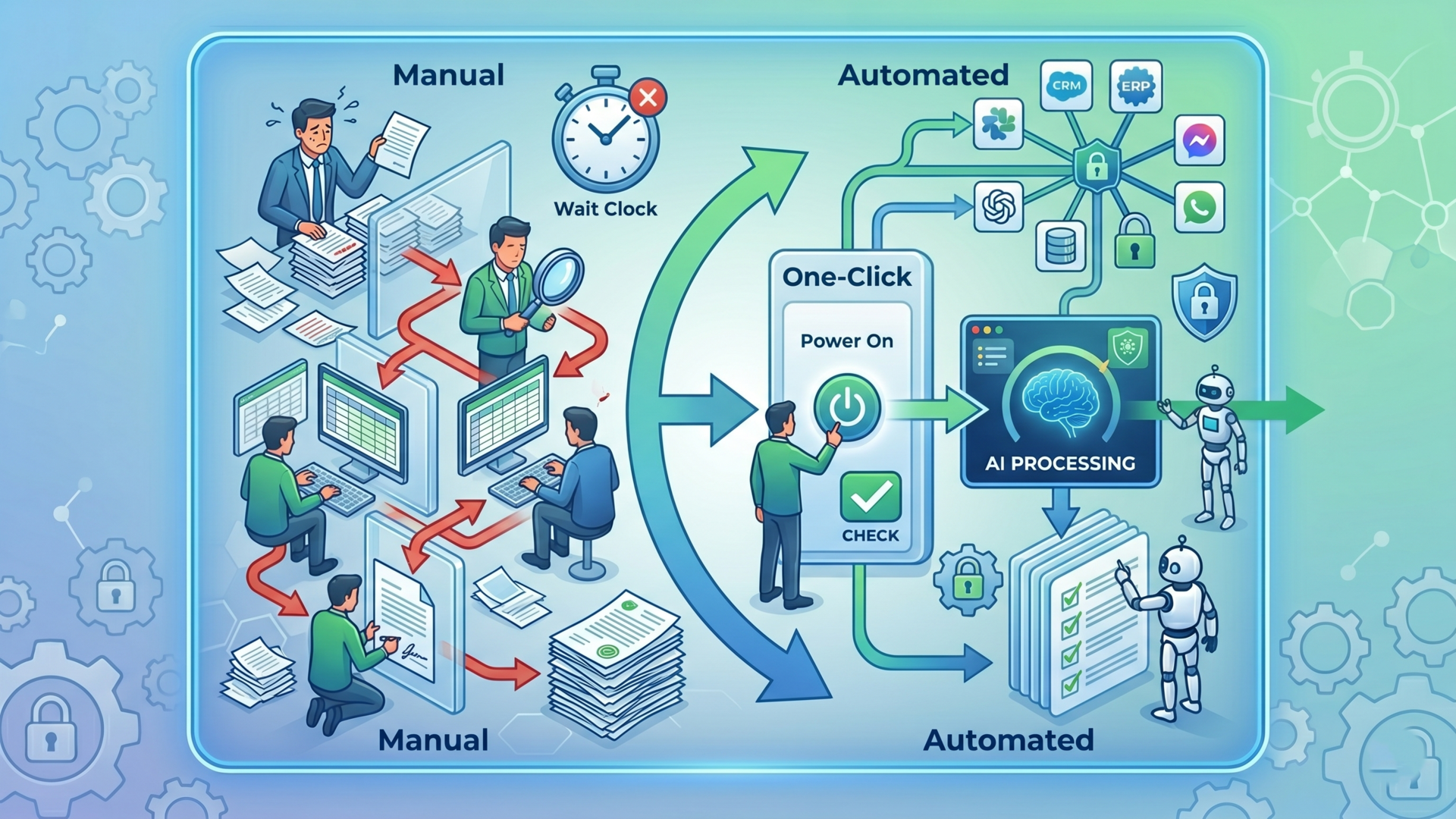
How to Turn Multi-Step Manual Work into One-Click Automated AI Pipelines
Key Strategic Takeaways for Enterprise Leaders
Audit for Friction First: Identify internal workflows requiring more than three manual handoffs or two hours of repetitive data manipulation; these are the prime candidates for automated AI pipelines.
Prioritize Data Security: Ensure all AI governance frameworks decouple public models from your proprietary data lakes using secure, enterprise-grade middleware and sandboxed execution environments.
Implement Human-in-the-Loop (HITL): Design your initial automated pipelines to act as co-pilots, routing final validations to human managers to maintain quality assurance while scaling operational capacity.
Build Modular Infrastructure: Deploy flexible orchestration layers rather than hard-coding to one specific LLM, allowing your enterprise infrastructure to seamlessly adapt as more powerful generative models emerge.
Enterprise operations are quietly stalling behind a wall of "hidden work." Modern teams spend up to 30% of their workday managing fragmented datasets, copy-pasting information across legacy software, manually validating compliance documents, and coordinating cross-department handoffs. This friction stifles innovation, drives up operational overhead, and introduces costly human errors into mission-critical workflows.
To remain competitive, organizations must transition from fragile, linear automation to intelligent, self-correcting systems.
Accelerating Enterprise Efficiency
Implementing automated AI pipelines for enterprises transforms high-friction, multi-step manual processes into unified, one-click digital workflows. By integrating advanced machine learning, orchestration layers, and agentic AI, these modern systems autonomously extract, process, structure, and route complex data across disparate corporate tools. The result is a highly scalable infrastructure that eliminates operational bottlenecks, maintains absolute compliance, and allows human talent to focus entirely on strategic decision-making.
The Core Blueprint of AI Workflow Automation
Traditional robotic process automation (RPA) relies on rigid, rule-based logic: if X happens, do Y. If the formatting of an invoice changes by even a single pixel, traditional RPA fails.
Modern enterprise AI automation, however, introduces semantic understanding and cognitive flexibility. Instead of breaking when data formats shift, unstructured data processing engines interpret intent, context, and structural nuance.
Key Technical Entities in an Automated Pipeline
To build resilient systems, architects orchestrate a specific stack of cognitive technologies:
Orchestration Layer: The central nerve center (e.g., LangChain, LlamaIndex, or custom enterprise middleware) that routes tasks between human inputs, internal data lakes, and generative models.
Vector Databases & RAG: Systems like Pinecone, Milvus, or Qdrant powering Retrieval-Augmented Generation to inject secure, real-time corporate knowledge bases directly into AI decision pathways.
Agentic AI & LLMs: Autonmous agents utilizing foundational LLMs capable of executing complex multi-step reasoning, tool-calling, and API executions.
AI Governance & Audit Trails: Continuous compliance tracking mechanisms that ensure data privacy, algorithmic transparency, and strict adherence to enterprise security parameters.
Manual vs. Automated AI Pipelines: An Enterprise Comparison
Real-World Transitions: Mapping Manual Friction to AI Pipelines
Turning a convoluted corporate process into a streamlined click requires systematic deconstruction. Here is how manual friction translates into high-efficiency AI workflow automation:
1. Inbound Enterprise Procurement & Vendor Onboarding
The Manual Way: A procurement manager receives unstructured PDFs, quotes, and compliance certificates via email. They manually extract pricing line items, paste them into an ERP (like SAP or Oracle), cross-reference data against internal policy documentation, and draft a confirmation email.
The AI Pipeline Way: An inbound webhook intercepts the email. An AI agent extracts data fields from the PDF, performs a RAG search against corporate vendor criteria, validates tax compliance parameters via API, logs the entries directly into the ERP database, and queues a perfectly formatted approval draft for human review.
2. Multi-Source Financial Reporting & Reconciliation
The Manual Way: Financial analysts pull quarterly transaction statements from five separate banking portals, three payment gateways, and internal ledgers. They spend days writing complex Excel VLOOKUPs to isolate discrepancies, flag anomalies, and generate summary reports for executives.
The AI Pipeline Way: Scheduled cron-jobs query banking and ledger APIs securely. An end-to-end data pipeline cleanses the transaction logs, executes semantic anomaly detection to instantly surface outliers, generates a consolidated financial health matrix, and synthesizes an executive narrative report in real time.
Cross-Industry Deep Dive: Where AI Pipelines Deliver 10x ROI
[Legacy Enterprise Data] ➔ [AI Extraction & RAG] ➔ [Agentic Reasoning & Compliance Guardrails] ➔ [One-Click API Execution / ERP Writeback]
Financial Services & Banking
In asset management and corporate banking, loan processing and Know Your Customer (KYC) compliance present massive operational bottlenecks. Automated pipelines ingestion engines analyze tax transcripts, credit reports, and legal filings simultaneously. By applying strict compliance automation guardrails, the system highlights potential risk indicators, verifies regulatory boundaries, and updates internal underwriting systems instantaneously.
Healthcare & Life Sciences
Clinical trial documentation and patient intake operations deal with highly confidential, deeply complex unstructured data. AI pipelines aggregate electronic health records (EHR), strip away personally identifiable information (PII) to meet strict privacy benchmarks, index symptom patterns against medical databases, and generate standardized compliance reports for healthcare providers without risking regulatory violations.
High-Growth B2B SaaS & Customer Operations
Customer success teams often navigate a maze of disparate product usage logs, CRM histories, and support tickets. An enterprise AI pipeline continuously aggregates customer touchpoints, interprets user sentiment trends through semantic analysis, anticipates potential churn indicators, and builds customized retention playbooks for account executives automatically.
Expert Tip: Architecting for Long-Term Resiliency
Enterprise Architect Insight
When engineering automated AI pipelines for enterprises, always decouple your data ingestion, cognitive processing, and action-execution layers. Treat foundational large language models as interchangeable commodities. By keeping your orchestration framework modular, you can plug in newer, faster, or more cost-effective models without rebuilding your entire enterprise data workflow from scratch. Always back every automated action with deterministic validation code to enforce structural compliance.
Frequently Asked Questions
What is the core difference between traditional RPA and automated AI pipelines?
Traditional Robotic Process Automation (RPA) requires static, predictable user interfaces and highly structured data inputs (such as explicit CSV spreadsheets). If an application layout shifts or an unexpected data format appears, RPA breaks. Automated AI pipelines utilize semantic understanding and advanced LLMs to successfully process unstructured text, dynamic documentation, and variable data layouts, adapting fluidly to variations without manual maintenance.
How do automated AI pipelines maintain enterprise data security?
Enterprise AI frameworks enforce security through private cloud deployments (VPC), strict data anonymization protocols, role-based access control (RBAC), and localized Vector Databases. By utilizing API-driven models with zero-data-retention policies, proprietary enterprise data is never used to train public foundational models.
Why is AI governance critical when scaling workflow automation?
AI governance ensures all automated actions remain transparent, explainable, and compliant with evolving international data regulations (such as GDPR or the EU AI Act). It provides enterprise compliance officers with detailed, algorithmic audit trails that document exactly how an AI system reached a specific operational decision or data output.
Supercharge Your Corporate Workflows with WPIntelliChat
Are you ready to eliminate operational drag, tear down manual data bottlenecks, and transition your workforce toward high-value strategic growth?
Building scalable, secure, and fully compliant automated AI pipelines for enterprises requires robust infrastructure, tailored integrations, and expert implementation. At WPIntelliChat, we specialize in engineering the intelligent orchestration layers, custom RAG systems, and enterprise-grade AI automation workflows that turn complex manual operations into seamless, one-click pipelines.
Contact our Enterprise Automation Team at WPIntelliChat today to schedule a custom architecture consultation and discover how to unlock exponential efficiency across your business infrastructure.